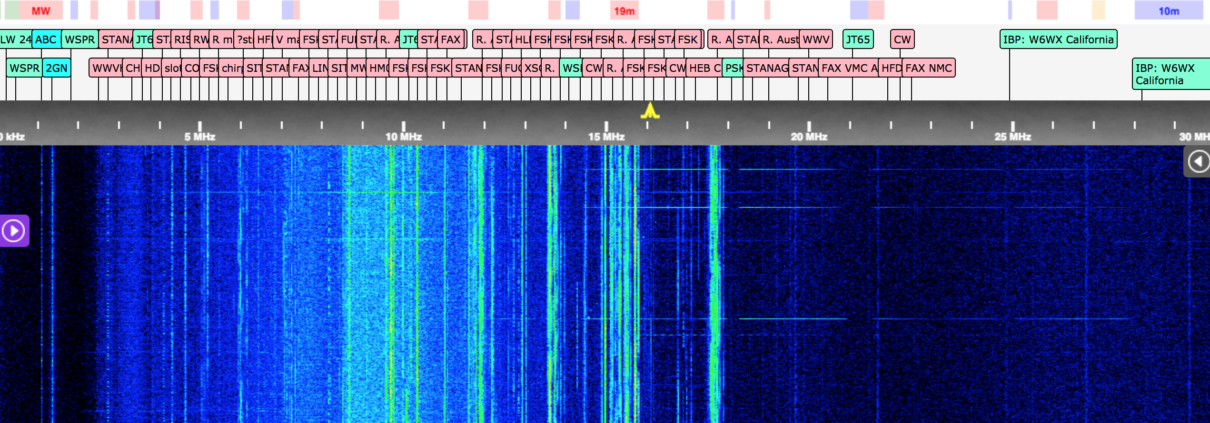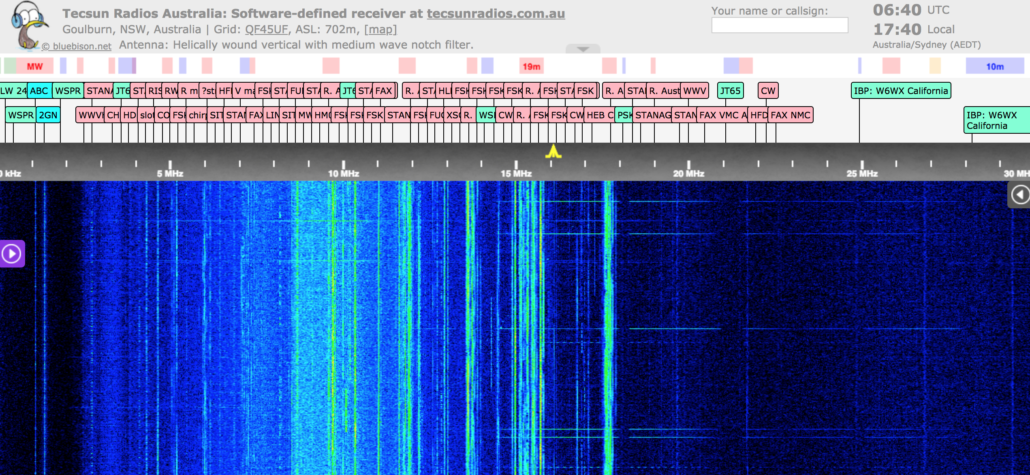




For many shortwave listeners and amateur radio operators, the Tecsun Radios Australia SDR is a valuable tool for tuning into signals that may be impossible to hear from their own location. Whether you’re listening to international broadcasts or monitoring amateur radio activity, the online receiver opens up a world of listening opportunities.
What many users may not realise, however, is that the Tecsun SDR can also be used as a highly effective HF propagation monitoring tool thanks to its integrated International Beacon Project (IBP) extension.
What is the International Beacon Project?
The International Beacon Project (IBP) is a worldwide network of 18 continuously operating CW beacons managed by the Northern California DX Foundation (NCDXF). These stations are strategically located across the globe and transmit continuously on a rotating schedule across five amateur radio bands.
By monitoring which beacons can be
heard and at what signal strengths, radio operators can gain valuable insight into current propagation conditions between different parts of the world.
Accessing the IBP Scan on the Tecsun SDR
Using the feature is straightforward.
Simply select “IBP Scan” from the “Extensions” menu within the Tecsun SDR interface. The receiver will then display a series of thumbnail spectrum windows while automatically scanning all 18 beacon locations.
By observing the spectrum displays and listening to the CW transmissions, users can assess how well radio signals are travelling fro
m various regions of the world to the SDR receiving site.
Beacon Locations Around the World
The IBP network includes stations in:
- New York City, USA (4U1UN)
- Canada (VE8AT)
- California, USA (W6WX)
- Hawaii (KH6RS)
- New Zealand (ZL6B)
- Perth, Australia (VK6RBP)
- Japan (JA2IGY)
- Siberia (RR9O)
- Hong Kong (VR2B)
- Sri Lanka (4S7B)
- South Africa (ZS6DN)
- Kenya (5Z4B)
- Israel (4X6TU)
- Finland (OH2B)
- Madeira (CS3B)
- Argentina (LU4AA)
- Peru (OA4B)
- Venezuela (YV5B)
Because these beacons are spread across every inhabited continent, they provide an excellent snapshot of global HF conditions at any given time.
Beacon Frequencies
Each beacon transmits on five amateur bands:
At any given moment, five different beacons are transmitting simultaneously, one on each band.
Understanding the Transmission Sequence
Each beacon transmits for a 10-second cycle before the next beacon takes its turn.
During this sequence, transmission power is progressively reduced to help listeners judge path quality:
- 0 to 5.5 seconds: Callsign transmitted in CW at 22 WPM using 100 watts
- 5.5 to 6.5 seconds: Long dash at 10 watts
- 6.5 to 7.5 seconds: Long dash at 1 watt
- 7.5 to 8.5 seconds: Long dash at 100 milliwatts
- 8.5 to 9.5 seconds: Long dash at 10 milliwatts
- 9.5 to 10 seconds: Silent period before the sequence repeats
The lower-power dashes are particularly useful. If you can still hear the beacon at 100 milliwatts or even 10 milliwatts, it indicates an exceptionally strong propagation path between the beacon location and the receiving station.
What Can You Learn?
The beauty of the IBP system is that it transforms the SDR into a real-time propagation monitoring station.
For example:
- Strong signals from North America may indicate favourable trans-Pacific conditions.
- Improved reception from Europe can signal an opening on higher-frequency bands.
- Weak or absent signals from traditionally reliable stations may suggest deteriorating propagation due to geomagnetic activity or changing solar conditions.
- Comparisons between bands can reveal which frequencies are currently performing best for long-distance communication.
For amateur radio operators planning DX contacts, this information can be invaluable in choosing the optimal band and time to operate.
A Powerful Tool Hidden in Plain Sight
Many listeners use the Tecsun SDR solely as a remote receiver, but the built-in IBP Scan extension offers a fascinating way to study HF propagation in real time. By monitoring beacon activity from 18 locations around the world and observing how signal strengths vary across five amateur bands, users can develop a deeper understanding of the constantly changing nature of the ionosphere.
Whether you’re a seasoned DXer, a contest operator, or simply curious about how radio waves travel around the globe, the IBP Scan feature is well worth exploring.
Image: IBP thumbnail scan display showing beacon frequencies and callsigns as viewed within the Tecsun SDR interface. http://www.tecsunradios.com.au/store/tecsun-sw-radio-online/